 Pompeii Tours from Rome
Pompeii and Herculaneum Tour from Rome: Both Sites in One Day
Last reviewed August 2026
A Pompeii and Herculaneum tour from Rome is an 11-hour day built around the high-speed train: 70 minutes to Naples, a van or coach to each site, two guided hours in Pompeii and 90 minutes to two hours in Herculaneum. Two of the twelve Rome tours we compare do it, and they are the only two that reach Herculaneum at all. This page sets out what each leaves you at each site, what the tickets cost (€16 at Herculaneum, €20 at Pompeii), why the smaller town is the quieter and in some ways the better-preserved one, and whether you can do the pair yourself from Rome without a tour. Herculaneum figures come from the park's own ticket page, checked on 29 August 2026.
Quick answer The train days that do both towns, the hours at each, and the train-only alternative
Two tours from Rome cover both sites in one day, both by high-speed train to Naples and then road. The Askos small-group day gives two guided hours in Pompeii and two in Herculaneum for $330 and names its Pompeii ticket as the €20 express grade. The ItaliaTours day gives two to two and a half hours in Pompeii, 90 minutes in Herculaneum and an hour for pizza, for $269 with a group of at most 20. Doing the pair yourself is cheaper and takes the same 11 hours, with the transfer between the sites and the discipline to leave Herculaneum on time as the hard parts.
Key takeaways
- The Askos two-site day: 2 h guided at each town, Pompeii Express ticket named
- The ItaliaTours day with lunch: best-rated tour on the site, Neapolitan pizza included
- Herculaneum costs €16, opens 08:30 and admits until 18:00 in summer; Pompeii costs €20 or €25 and admits until 17:30
- Herculaneum keeps its carbonised wood and upper storeys; Pompeii has the Forum, the casts and 66 hectares
- Going on your own? The DIY train day on the homepage covers the Rome to Pompeii leg; Herculaneum is one stop earlier on the same line
The Rome Tours That Do Both That Reach Herculaneum
Only two of the twelve Pompeii tours from Rome we compare visit Herculaneum; the rest pair Pompeii with the coast, Naples or Vesuvius. Both use the high-speed train from Roma Termini and both run about 11 hours. Times are each operator's itinerary as printed on the operators' listings on 29 August 2026; prices are the lowest adult rate shown that day.
| Askos small-group day | ItaliaTours day with lunch | |
|---|---|---|
| From | $330 | $269 |
| Rating | 4.8 from 465 reviews | 4.9 from 210 reviews |
| Train | You book onto the Frecciarossa yourself with pre-booked tickets; meet at Starhotel Terminus opposite Napoli Centrale | Escorted from Caffè Vergnano inside Termini, 70 minutes to Naples |
| Pompeii | 2 h guided with an archaeologist, headsets | 2.5 h guided on the itinerary, 2 h in the description |
| Herculaneum | 2 h guided | 1.5 h guided |
| Pompeii ticket | Pompeii Express, named in writing | Skip-the-line entry, grade not stated |
| Herculaneum ticket | Included, printed at €16 | Included |
| Lunch | Not included; 50 minutes at Maximall Pompeii with a discount card | Neapolitan pizza in a converted rail station, 1 h |
| Group | Shared van or minibus | Coach, maximum 20 |
| Day length | 11 h | 11 h |
The Askos day buys more Herculaneum, half an hour more, and the certainty of knowing your Pompeii grade. The ItaliaTours day buys an escort on the train, a smaller stated group, a meal and a lower price. Both put about a mile of walking into Pompeii and half a mile into Herculaneum; Askos bans sandals and flip-flops and warns that large luggage may not fit its minibus.
Neither is suitable for wheelchair users. Where they sit against the ten Pompeii-only and combo days is on the homepage.
What You See at Each Site
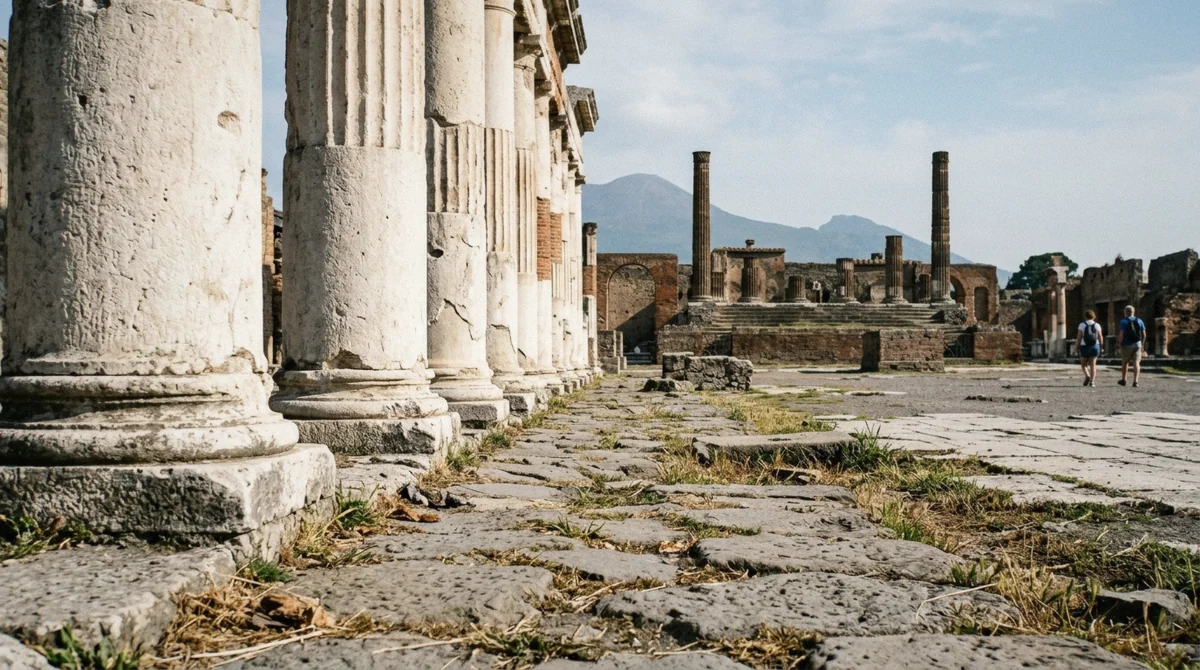
One eruption in AD 79 buried the two towns in different ways. Pompeii lay downwind and took hours of falling pumice and ash; roofs collapsed, wood rotted, and what survived was the plan of a whole city and the voids that became the casts. Herculaneum was hit by pyroclastic surges, fast clouds of hot gas and debris that carbonised timber instead of burning it and sealed the town under a deposit that set like rock.
The wood is still there, black and cracked but in place: beams across ceilings, door frames, a screen, shelving. Herculaneum has upper storeys you can look up into. Pompeii has horizons.
| Pompeii | Herculaneum | |
|---|---|---|
| Adult ticket | €20 express, €25 Pompeii+ with the villas | €16 |
| Reduced, EU 18 to 24 | €2 | €2 (18 to 25) |
| Summer hours, 16 March to 14 October | 09:00 to 19:00, last entry 17:30 | 08:30 to 19:30, last entry 18:00 |
| Winter hours, 15 October to 15 March | 09:00 to 17:00, last entry 15:30 | 08:30 to 17:00, last entry 15:30 |
| Closed | 25 December, 1 January | 25 December |
| Free days | First Sunday of the month | First Sunday, plus 25 April, 2 June, 4 November |
| Scale | About 66 hectares, a city of streets, Forum, amphitheatre, theatres, baths | A few excavated hectares of a wealthy seaside town of about 5,000 |
| What is unique | The casts, the Forum with Vesuvius behind it, the Villa of the Mysteries on the dearer ticket | Carbonised wood, upper floors, marble cladding, the skeletons in the boat houses |
| Currently closed | Individual houses rotate | Villa dei Papiri and the Theatre, no reopening date |
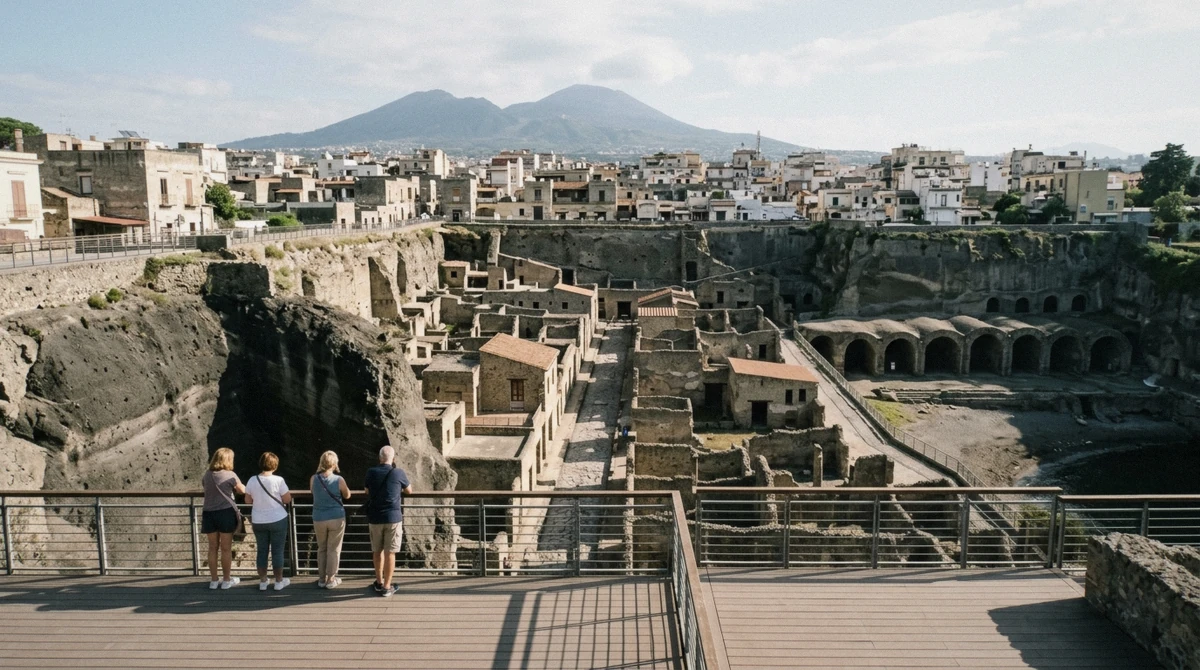
Herculaneum feels quieter for three reasons that have nothing to do with fashion. The excavated area is a fraction of Pompeii's, so a group of 20 fills a street. Coach tours from Rome do not go there, so the morning wave that hits Porta Marina at 10:00 has no equivalent at Ercolano. And the site sits in a pit below the modern town, so you walk in along a terrace, look down on the whole grid, and then go down into it, which is a different experience from walking through a gate into a city.
The skeletons are real. Hundreds were found in the vaulted boat houses along the ancient shoreline in excavations of 1980 and 1981, people who had fled to the waterfront and were killed by the first surge. Pompeii's casts are plaster poured into voids; Herculaneum's dead were found as bone. Guides on both tours stop at the boat houses.
How the 11-Hour Day Runs
Herculaneum sits about 20 km before Pompeii on the A3, at the Ercolano exit, which is why a Rome tour adds only about 30 minutes of driving to reach it. Both tours do Pompeii first and Herculaneum after, which puts the larger, hotter, busier site into the morning. The composite timeline below is built from the two itineraries and the train times the operators print; the exact train depends on your date.
| Leg | Askos | ItaliaTours |
|---|---|---|
| Roma Termini departure | Your own Frecciarossa, early morning | Escorted, 70 min to Napoli Centrale |
| Naples to Pompeii | 30 min by van | 30 min briefing, then 30 min by coach |
| Pompeii | 2 h guided | 2 to 2.5 h guided |
| Lunch | 50 min at Maximall Pompeii, own expense | 1 h pizza, included |
| Pompeii to Herculaneum | About 30 min | Short transfer |
| Herculaneum | 2 h guided | 1.5 h guided |
| Back to Rome | Van to Naples, your own train | Coach and escorted train |
| Total | 11 h | 11 h |
One practical difference: Askos meets you in Naples, at the Starhotel Terminus opposite the station, so the Rome to Naples leg is yours to catch and yours to miss. ItaliaTours walks you from Caffè Vergnano on the departures level of Termini onto the train. If you have never used an Italian high-speed platform, that escort is worth something on a day with no slack; if you have, it is not.
Can You Do Both from Rome Without a Tour?
Yes, and the railway does most of the work. Frecciarossa or Italo from Roma Termini reaches Napoli Centrale in about 70 minutes, with Italo publishing fares from €14.90 one way and Trenitalia's same-day return discount taking 30 per cent off Sunday to Friday and 50 per cent on Saturdays. Under the station, the Circumvesuviana towards Sorrento stops at Ercolano Scavi after about 20 minutes and at Pompei Villa dei Misteri after 35 to 40, so both sites sit on one line in the right order. The Pompei fare is €3.30 on the EAV band; Ercolano is a shorter ride on the same line, and we have not verified its band, so check it at the machine.
At Ercolano Scavi you walk about ten minutes downhill through the modern town to the entrance. At Pompei the gate is a hundred metres from the platform. The two tickets, €16 and €20, are bought separately: Herculaneum at the gate or online, Pompeii through vivaticket with a booked slot in summer.
Do Herculaneum first, at 08:30 when it opens and while Pompeii fills with coaches, then ride two stops on to Pompei for the afternoon, when the 13:00 to 17:30 window holds a third of the morning's crowd. The trap is time: two hours at Herculaneum becomes three without a guide to move you, and Pompeii's last entry is 17:30 in summer and 15:30 in winter. A winter two-site day on your own is tight enough that the tours, which walk you out of Herculaneum on the clock, are the safer bet. The Rome to Pompeii train day is costed in full on the homepage, and the train guide covers fare classes and the Sunday direct service.
From Naples the pair is a much shorter day, with no 70-minute train at either end; Pompeii tours from Naples is our guide to that version.
Which Way to See Both
If You want the most Herculaneum and a stated ticket grade
The Askos small-group day, two guided hours at each site
If You want an escort from Termini, lunch and a lower price
The ItaliaTours day with pizza, groups of 20 at most
If You are happy on Italian trains and want to save the guide fee
Frecciarossa to Naples, Circumvesuviana to Ercolano Scavi, then two stops on to Pompei. Start at 08:30 and leave Herculaneum by 11:00
If You are visiting between 15 October and 15 March
Take a tour. Last entry at both sites is 15:30 and a self-guided two-site day runs out of daylight
If You only have time for one
Pompeii for the scale and the casts; Herculaneum if you would rather stand inside a Roman house than look at the plan of a city
If You are sleeping in Naples rather than Rome
Use the Naples guide instead; the day is hours shorter from there
If You Must Choose One from Rome
Ten of the twelve Rome tours choose for you, and they choose Pompeii. That is the right default for a first visit: the Forum, the Stabian Baths, a bakery with its millstones, the Lupanare, the casts in the granary, and the amphitheatre if your tour reaches the east end, which the 90-minute coach walks do not. How long each tour spends inside is the number that separates them.
Herculaneum wins on a second visit, in heat, or with anyone who tires quickly: it is compact, partly shaded by its own upper floors, and empty by comparison. It also wins for anyone whose interest is domestic rather than civic, because the houses stand to their lintels and the marble is still on the walls. What it lacks is the sense of a whole city, and from Rome no tour goes there alone, so seeing it means the two-site day or the train on your own.
The honest answer to the question in this page's title is that from Rome you do not have to choose. The train days above give you both for the cost of an 11-hour day, and the difference between them is half an hour of Herculaneum against a plate of pizza and $61.
Pompeii and Herculaneum from Rome: Questions
Can you do both Pompeii and Herculaneum in one day from Rome?
Yes. Two tours do it in about 11 hours by high-speed train and road, with two hours guided in Pompeii and 90 minutes to two hours in Herculaneum. Independently it is the same length by Frecciarossa and the Circumvesuviana, with Ercolano Scavi one stop before Pompei on the same line.
Why isn't Herculaneum as famous as Pompeii?
Scale and access. Pompeii is a city of about 66 hectares with a Forum, an amphitheatre and the casts; Herculaneum's excavated area is a few hectares under a modern town. Coach tours from Rome go to Pompeii only, so most visitors never see the smaller site.
Are the skeletons in Herculaneum real?
Yes. Hundreds of skeletons were found in the boat houses along the ancient shoreline in 1980 and 1981, people killed by the first pyroclastic surge. Pompeii's figures are plaster casts poured into voids left by bodies in the ash; Herculaneum's are bone.
How much are Herculaneum tickets?
€16 for an adult and €2 reduced for 18 to 25 year olds, on the park's own ticket page in August 2026. Entry is free on the first Sunday of the month and on 25 April, 2 June and 4 November. Both two-site tours from Rome include the ticket.
What are Herculaneum's opening hours?
08:30 to 19:30 with last entry at 18:00 from 16 March to 14 October, and 08:30 to 17:00 with last entry at 15:30 from 15 October to 15 March. Closed on 25 December. The Villa dei Papiri and the Theatre are closed for works with no reopening date.
Which is better preserved, Pompeii or Herculaneum?
Herculaneum, for buildings. Pyroclastic surges carbonised its wood and sealed it under a hard deposit, so beams, doors and upper floors survive. Pompeii's slower burial under pumice collapsed roofs, but preserved the plan of a whole city and the voids that became the casts.
Which tour from Rome includes Herculaneum?
Two: the Askos small-group day by train and minibus, and the ItaliaTours day by train and coach with pizza lunch. No coach day trip from Rome goes to Herculaneum.
From Rome the question is rarely one or the other; it is whether the second site is worth two more hours and an earlier train. It is, if you have already seen a Roman city and want to see a Roman house. Every Pompeii tour from Rome we compare lists its hours at each site, and the two that reach Herculaneum are the ones to read first.